

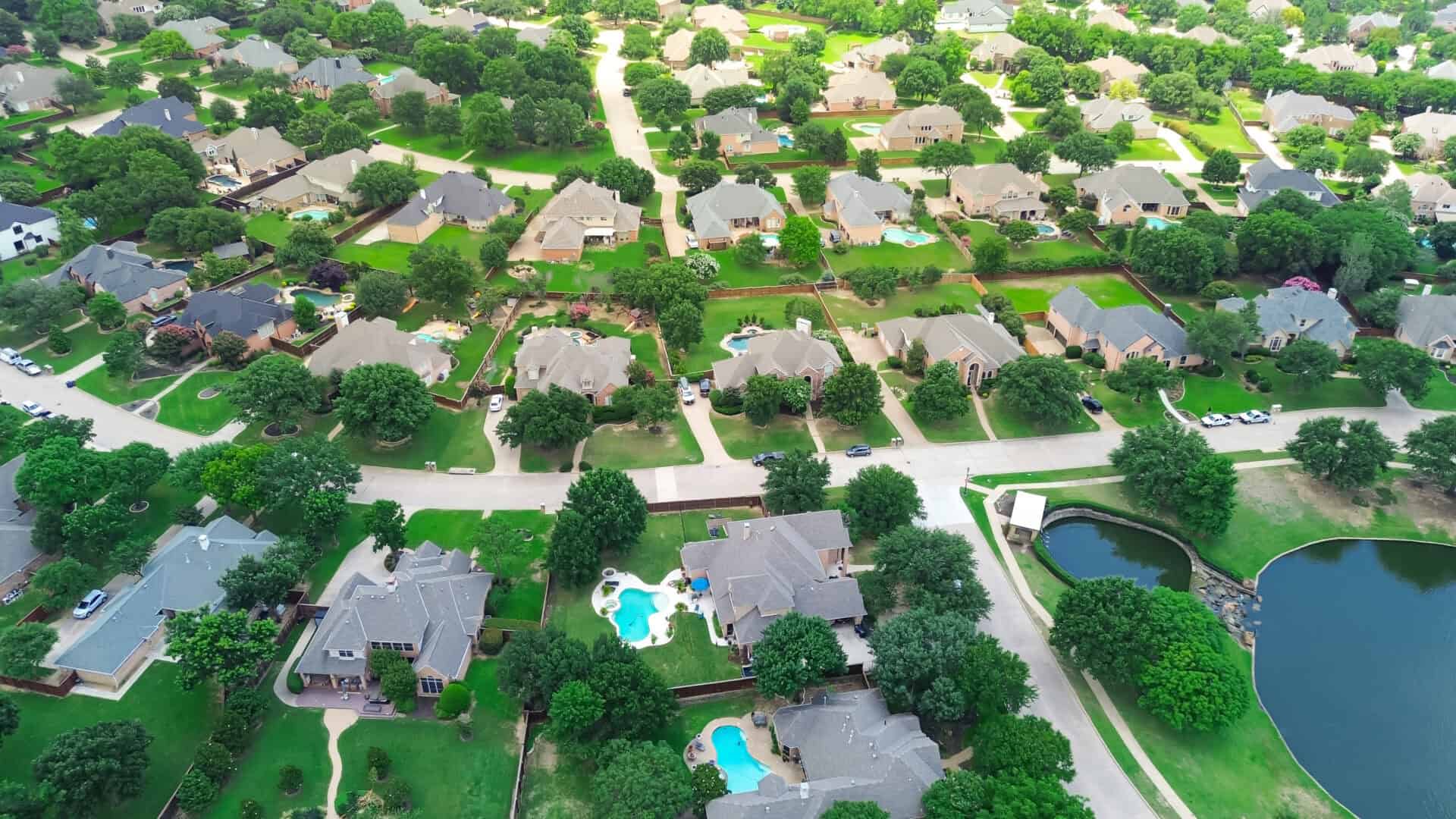
Roofing on the Lake: What Lake Dallas, Corinth and Hickory Creek Homes Deal With
Quick Answer
Homes around Lewisville Lake face three conditions inland homes do not: stronger sustained wind with no windbreak, higher humidity that keeps shaded slopes damp and encourages algae and moss, and mature tree cover that drops debris and clogs gutters. Together these shorten roof life. Lake-area homes benefit from higher wind-rated shingles, proper starter strip at the edges, algae-resistant shingles on shaded slopes, balanced attic ventilation, and gutter cleaning twice a year.
Roofs around Lewisville Lake age differently than roofs ten miles inland, and homeowners there are often surprised by it.
Same builders in many cases, same materials, same storms moving through. But the roof on a house off Swisher Road in Lake Dallas is working against a different set of conditions than one in a newer Denton subdivision, and those conditions shorten its life in specific, predictable ways.
Here is what is actually different, and what it changes about how these roofs should be maintained and built.
Wind Exposure Without a Windbreak
Open water does not slow wind down.
Inland neighborhoods break up wind through sheer density, as houses, fences and mature trees all shed energy before it reaches any single roof. A home with open water on its windward side gets wind at closer to full strength, with gusts arriving with less turbulence and more sustained force.
This matters most at the edges. Wind damage to a shingle roof almost always starts at a perimeter or a ridge, where it can get underneath a tab and lift. Once one shingle breaks its seal, the one above it is exposed, and failure propagates.
What that means for lake-adjacent homes:
- Starter strip quality is not optional. A proper manufactured starter course along eaves and rakes resists uplift far better than cut-up field shingles used as starter. This is a shortcut we find regularly, and on exposed lots it shows up as missing edge shingles within a few years.
- Wind rating is worth paying for. The cost gap between a 110 mph and a 130 mph rated shingle is small relative to a replacement.
- Ridge caps take a beating. Purpose-made ridge cap outlasts field shingles bent over a ridge.
- Perimeter fastening matters. Correct nail placement and count along edges is where wind resistance is won or lost.
Humidity That Does Not Clear
Proximity to a large body of water means higher ambient humidity, and it lingers, particularly on north-facing slopes that get little direct sun to dry them out.
| Growth | What It Looks Like | Risk to the Roof |
|---|---|---|
| Algae | Black streaks running down the slope | Low, mostly cosmetic, but holds moisture |
| Moss | Green, raised, fuzzy clumps on shaded slopes | Moderate to high, lifts shingle edges |
| Lichen | Crusty pale grey-green spots that cling tightly | Moderate, roots grip and pull granules loose |
Algae-resistant shingles with copper granules are a worthwhile upgrade on shaded lake-area roofs. Moss is the one to take seriously, because it holds water directly against shingles and its root structure lifts edges. It needs removing carefully, since pressure washing a shingle roof destroys it, and we covered the right method in how to remove moss from a roof without damaging it.
Humidity also raises the stakes on attic ventilation. Warm moist air entering an under-ventilated attic condenses on the underside of the decking, and sustained condensation rots decking from beneath while the shingles above still look fine. More in why attic ventilation is everything.
Mature Tree Cover
The established lake neighborhoods, including older parts of Lake Dallas and the wooded sections of Hickory Creek, have tree canopy that newer developments simply do not.
Shade is a genuine benefit. It reduces thermal cycling and takes real load off a roof in August. The costs come with it:
- Constant organic debris accumulating in valleys and behind chimneys, holding moisture against the roof.
- Gutters that clog faster. A home under oaks needs gutter cleaning on a different schedule than one in an open subdivision.
- Abrasion from limbs resting on or near the roof, wearing through granules every time the wind moves them.
- Storm risk, since a limb close to the roof becomes a limb through the decking in a severe storm.
- Animal access, as overhanging branches are a bridge for squirrels and raccoons looking for soffit gaps.
Keep limbs trimmed back roughly ten feet from the roof surface where you can.
Same Hail, More Total Load
Lake proximity does not change hail exposure. Denton County storms affect Corinth and Hickory Creek the same way they affect Denton, and we handle hail and storm damage across all of it.
What changes is the cumulative picture. A lake-area roof arrives at a hailstorm having already absorbed more wind cycling, more moisture exposure and more organic debris than an inland roof of the same age. A storm that a sheltered eight-year-old roof shrugs off can push an exposed eight-year-old roof over the line.
It also complicates claims. Carriers distinguish storm damage from accumulated wear, and a roof carrying more wear going in gives an adjuster more room to attribute failures to age. That makes documentation matter more, not less, as we covered in hail damage versus normal wear.
What We Recommend for Lake-Area Homes
- Inspect twice a year rather than once, in spring after storm season and in autumn before winter.
- Clean gutters on a tree-cover schedule, twice a year minimum under mature canopy.
- Specify algae-resistant shingles on replacement, since on a shaded lake lot the premium pays for itself in appearance alone.
- Do not under-buy on wind rating. Exposure is the whole argument for the upgrade.
- Take ventilation seriously, because you are managing moisture as well as heat.
- Watch the north slopes. They dry slowest and show moisture problems first.
Frequently Asked Questions
Do lake homes need different roofing than inland homes?
The materials are the same, but the specification should differ. Higher wind ratings, algae-resistant shingles and properly balanced ventilation all matter more near open water.
Why does my lake house roof have more algae than my old house?
Higher ambient humidity near the water, combined with shade from mature trees, keeps slopes damp longer. Algae feeds on limestone filler in shingles and thrives in those conditions.
How often should I clean gutters near the lake?
Twice a year at minimum under mature tree cover, and more often if you have heavy leaf drop. Overflowing gutters damage fascia and saturate the ground at your foundation.
Does wind damage look different from hail damage?
Yes. Wind damage concentrates at edges and ridges, producing lifted, creased or missing shingles. Hail damage is randomly distributed with bruising and circular granule loss.
Are impact-resistant shingles worth it on a lake home?
Often yes, since you get both the hail benefit and typically a higher wind rating. Many Texas carriers also offer a premium discount. See impact-resistant shingles for North Texas homes.
Which areas around the lake do you serve?
Lake Dallas, Corinth, Hickory Creek, Lantana, Argyle and Oak Point, among others across Denton County.
Roofing Near the Lake?
Epic Roofing & Construction is a family-owned, GAF Master Elite roofing contractor in Denton with a BBB A+ rating. We are based on Market Street, which puts Lake Dallas, Corinth and Hickory Creek a short drive away, and a good share of our work comes from these neighborhoods. When a storm comes through, out-of-state crews follow it and leave. We are still here, and so is our warranty. Call (972) 798-7874 or contact us online for a free residential roofing inspection.
Start Your Roofing Project With Confidence Today
Get Started Today